SIOS SANless clusters

SIOS SANless clusters High-availability Machine Learning monitoring

  • Home
  • Products
    • SIOS DataKeeper for Windows
    • SIOS Protection Suite for Linux
  • News and Events
  • Clustering Simplified
  • Success Stories
  • Contact Us
  • English
  • 中文 (中国)
  • 中文 (台灣)
  • 한국어
  • Bahasa Indonesia
  • ไทย

How to Deliver High Availability for SQL Server in Linux Environments

September 10, 2020 by Jason Aw Leave a Comment

How to Deliver High Availability for SQL Server in Linux Environments

How to Deliver High Availability For SQL Server in Linux Environments

If your organization is running business-critical Microsoft SQL Server on Linux, your IT team undoubtedly knows how challenging continually maintaining high availability, performance and security can be. Particularly difficult is how to ensure high availability with robust replication and automatic failover. Using open-source software and an easily configured HA SANless cluster solution can offer a simpler maintenance approach without sacrificing the safety and performance your organization requires.

Limited High Availability Options for Linux

Most Linux distributions give IT departments two inferior choices for high availability: either pay more for the SQL Server Enterprise Edition to implement Always On Availability Groups, or struggle to make complex do-it-yourself HA Linux configurations work well—something that can be extraordinarily difficult to do.

The problem with using the Enterprise Edition is that it undermines the cost-saving strategy for using an open-source operating system on commodity hardware. For a limited number of small SQL Server applications, it might be possible to justify the additional cost. But it’s too expensive for many database applications and will do nothing to provide general-purpose HA for Linux.

Providing HA across all applications running in a Linux environment is possible using open-source software, such as Pacemaker and Corosync, or SUSE Linux Enterprise High Availability Extension. But getting the full software stack to work as desired requires creating (and testing) custom scripts for each application, and these scripts often need to be retested and updated after even minor changes are made to any of the software or hardware being used. Availability-related capabilities that are unsupported in both SQL Server Standard Edition and Linux can make this effort more challenging.

Finding an Alternative High Availability Solution for SQL Server in Linux

To make HA both cost-effective and easy to implement, you may want to consider two different, general-purpose approaches.

One is using storage-based systems that protect data by replicating it within a redundant and resilient storage area networks (SANs). This approach is agnostic with respect to the host operating system, but it requires that the entire SAN infrastructure be acquired from a single vendor and relies on separate failover provisions to deliver high availability.

The other approach is host-based and involves creating a storage-agnostic SANless cluster across Linux server instances. As an HA overlay, these clusters are capable of operating across both the LAN and WAN in private, public and hybrid clouds. The overlay is also application-agnostic, enabling organizations to have a single, universal HA solution across all applications. While this approach does consume host resources, these are relatively inexpensive and easy to scale in a Linux environment.

Most HA SANless cluster options provide a combination of real-time block-level data replication, continuous application monitoring, and configurable failover/failback recovery policies to protect all business-critical applications, including those using Always On Failover Cluster Instances available in the Standard Edition of SQL Server.

SIOS Technology Corp. offers more robust HA SANless cluster solutions for Linux with advanced capabilities that are designed to free IT from the complexity and daily challenges of supporting and optimizing computing infrastructures. The SIOS Protection Suite solution with LifeKeeper provides:

  • Continuous monitoring of the entire Linux application stack
  • Complete Application-Aware Protection with its application recovery kits (ARK) for fast, safe recovery or failover of complex applications and databases
  • Wizard-driven setup for Linux clustering
  • Configuration flexibility, such as using a traditional shared-storage cluster or software to synchronize local storage in a SANless cluster configuration

For example, a SANless cluster can handle two concurrent failures. The basic operation is the same in the LAN and WAN, as well as across private, public, and hybrid clouds.
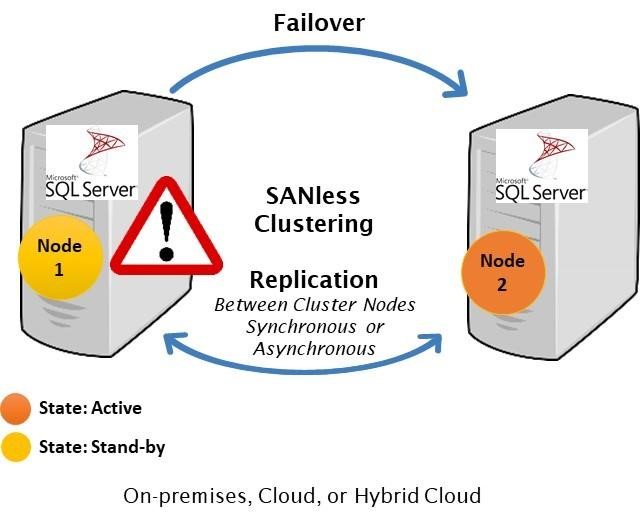
In a typical two-node cluster server #1 is initially the primary that replicates data to servers #. It experiences a problem, automatically triggering a failover to server #2, which now becomes the primary.

In this situation, the IT department would likely begin diagnosing and repairing whatever problem caused server #1 to fail. Once fixed, it could take over as the primary or server #2 could continue in that capacity replicating data to servers #1.

With most HA SANless clustering configurations, failovers are automatic, and both failovers and failbacks can be controlled by a browser-based console.

For further information about SIOS LifeKeeper and Protection Suite solutions, visit SIOS SAN and SANless High Availability Clusters for Cluster Server Environments.

Reproduced with permission from SIOS

Filed Under: Clustering Simplified Tagged With: High Availability, Linux, SQL Server High Availability

Webinar: Why Clustering for SQL Server High Availability?

May 24, 2019 by Jason Aw Leave a Comment

Why Clustering for SQL Server High Availability

Webinar: Why Clustering for SQL Server High Availability?

Webinar: Why Clustering for SQL Server High Availability?

When it comes to SQL Server high availability (HA), SQL Server Failover Cluster Instance (FCI) has been the standard since 1998 with the release of SQL Server 7. Dave Bermingham, Microsoft Cloud and Datacenter MVP and former Cluster MVP, reviews what clusters are, why you should use them for high availability, discusses SQL Server Failover Cluster Instance concepts and why it is an important part of your Mission Critical SQL Server deployment whether you run on-premises, in the cloud or in a hybrid cloud configuration.

Register Webinar: Why Clustering for SQL Server High Availability?

Filed Under: News posts Tagged With: Clustering, Failover Clusters, High Availability, SQL Server, SQL Server High Availability

Webinar: Delivering Microsoft SQL Server High Availability on AWS

May 24, 2019 by Jason Aw Leave a Comment

Delivering Microsoft SQL Server High Availability on AWS

Webinar: Delivering Microsoft SQL Server High Availability on AWS

You can use AWS services like Amazon EC2 and Amazon RDS to quickly build, deploy, scale and manage your SQL Server databases, which helps you build more agile applications. This webinar covers best practices for running SQL Server business-critical applications on AWS. Zlatan Dzinic, of AWS, and Dave Bermingham, of SIOS Technology Corp., discuss how to choose between Amazon EC2 and Amazon RDS, and above all, get an overview of the AWS highly reliable, scalable and low cost infrastructure combined with SIOS DataKeeper for high availability platform – providing customers with a powerful solution to ensure improved IT responsiveness and compelling ROI for business-critical applications.

Register Webinar: Delivering Microsoft SQL Server High Availability on AWS

Filed Under: News and Events Tagged With: AWS Cloud, High Availability, SQL Server, SQL Server High Availability

Webinar: Leveraging Storage Spaces Direct for SQL Server High Availability

May 20, 2019 by Jason Aw Leave a Comment

Leveraging Storage Spaces Direct for SQL Server High Availability


Webinar: Leveraging Storage Spaces Direct for SQL Server High Availability

Windows Server 2016 introduced storage capabilities that made it possible to deploy SQL Server failover clustered instances (FCI) without the traditional storage area network (SAN) arrays. In this webinar, learn how you can leverage Storage Spaces Direct (S2D) for deploying SQL Server failover clustered instances to provide high availability to your SQL Server databases. We also look at some of the things to watch out for when deploying SQL Server FCIs on S2D.

Register Webinar: Leveraging Storage Spaces Direct for SQL Server High Availability

Filed Under: News and Events Tagged With: disaster recovery - DR, Failover Clusters, High Availability, SQL Server Failover Clusters, SQL Server High Availability

On-Demand Webinar: SQL Server High Availability in the cloud

May 17, 2019 by Jason Aw Leave a Comment

SQL Server High Availability in the cloud

On-Demand Webinar: SQL Server High Availability in the cloud

On-Demand Webinar: SQL Server High Availability in the cloud

Experts Share FAQs, Common Misconceptions and Resources about High Availability in the Cloud

Watch the panel discussion with top cloud, Datacenter and SQL professionals as they cover best practices, frequently asked questions, and common mistakes they encounter in their professions.

This panel covers topics including SQL Server, upgrades, failover, cloud and best practices. They also point out easy to access resources you may need in the future.

Register Webinar: SQL in the cloud – FAQs, common misconceptions and resources to make your life easier

Filed Under: News and Events Tagged With: AWS QuickStart, HA clusters-cloud, SQL Server Failover Clusters, SQL Server High Availability

  • « Previous Page
  • 1
  • 2
  • 3
  • 4
  • Next Page »

Recent Posts

  • What Is High Availability (HA)?
  • Surviving the Friday Night Crash: From Scrappy Bare Metal to Seamless Data Replication
  • Grounded: What Missing Percona Live Amsterdam Taught Me About HA
  • SIOS LifeKeeper vs. Red Hat High Availability Add-On:
  • The State of Application Resilience: 2026 SIOS High Availability Survey

Most Popular Posts

Maximise replication performance for Linux Clustering with Fusion-io
Failover Clustering with VMware High Availability
create A 2-Node MySQL Cluster Without Shared Storage
SAP for High Availability Solutions For Linux
Bandwidth To Support Real-Time Replication
The Availability Equation – High Availability Solutions.jpg
Choosing Platforms To Replicate Data - Host-Based Or Storage-Based?
Guide To Connect To An iSCSI Target Using Open-iSCSI Initiator Software
Best Practices to Eliminate SPoF In Cluster Architecture
Step-By-Step How To Configure A Linux Failover Cluster In Microsoft Azure IaaS Without Shared Storage azure sanless
Take Action Before SQL Server 20082008 R2 Support Expires
How To Cluster MaxDB On Windows In The Cloud

Join Our Mailing List

Copyright © 2026 · Enterprise Pro Theme on Genesis Framework · WordPress · Log in