SIOS SANless clusters

SIOS SANless clusters High-availability Machine Learning monitoring

  • Home
  • Products
    • SIOS DataKeeper for Windows
    • SIOS Protection Suite for Linux
  • News and Events
  • Clustering Simplified
  • Success Stories
  • Contact Us
  • English
  • 中文 (中国)
  • 中文 (台灣)
  • 한국어
  • Bahasa Indonesia
  • ไทย

SQL Saturday: High Availability and Disaster Recovery for SQL Server in Azure IaaS

August 23, 2019 by Jason Aw Leave a Comment

High Availability and Disaster Recovery for SQL Server in Azure IaaS

Speaker: Jason Aw

Duration: 60 minutes

Level: Beginner

Track: Application, DBA and Database Development

The CEO just tasked you with moving all the SQL Server instances to Azure, or maybe you are deploying a brand new application and want to leverage Azure IaaS to host SQL Server. Beyond security and performance, your most pressing concern might be ensuring SQL Server running in Azure is highly available.

While on-prem high availability and disaster recovery options for SQL Server are well defined, moving those instances to Azure immediately presents some questions and challenges. Can I simply lift and shift my SQL Server Failover Cluster Instance to the cloud? Do I need to upgrade to SQL Server Enterprise Edition and us Always On Availability Groups? What about shared storage and failover clustering? What about disaster recovery, what are my options there? Load Balancers, Fault Domains, Availability Zones, Azure Site Recovery and Region Pairs, what are these things and why do they matter to me?

High Availability and Disaster Recovery professional Jason Aw with 20 years of experience explains all this and more in detail.

Accompanying Material

  • [Powerpoint] – PASS_Perth_SQLSaturday_2019_SIOS_Datakeeper_HA_DR.pdf

Filed Under: News and Events Tagged With: disaster recovery, High Availability

SQL Saturday: High Availability and Disaster Recovery for SQL Server in Azure IaaS

August 23, 2019 by Jason Aw Leave a Comment

SQL Saturday: High Availability and Disaster Recovery for SQL Server in Azure IaaS

Speaker: Jason Aw

Duration: 60 minutes

Level: Beginner

Track: Enterprise Database Administration & Deployment

The CEO just tasked you with moving all the SQL Server instances to Azure, or maybe you are deploying a brand new application and want to leverage Azure IaaS to host SQL Server. Beyond security and performance, your most pressing concern might be ensuring SQL Server running in Azure is highly available.

While on-prem high availability and disaster recovery options for SQL Server are well defined, moving those instances to Azure immediately presents some questions and challenges. Can I simply lift and shift my SQL Server Failover Cluster Instance to the cloud? Do I need to upgrade to SQL Server Enterprise Edition and us Always On Availability Groups? What about shared storage and failover clustering? What about disaster recovery, what are my options there? Load Balancers, Fault Domains, Availability Zones, Azure Site Recovery and Region Pairs, what are these things and why do they matter to me?

High Availability and Disaster Recovery professional Jason Aw with 20 years of experience explains all this and more in detail.


For more details, please click here

Filed Under: News and Events Tagged With: disaster recovery, High Availability, high availability and disaster recovery

Webinar: Availability Options and Requirements for SQL Server 2008 in Azure

May 25, 2019 by Jason Aw Leave a Comment

Availability Options and Requirements for SQL Server 2008 in Azure

Webinar: Availability Options and Requirements for SQL Server 2008 in Azure

Time is running out for your SQL Server 2008/2008 R2 instances. On July 9th the extended support date for SQL Server 2008/2008 R2 officially runs out. This means no more security updates will be issued. But wait, there is an option. By moving your SQL Server 2008/2008 R2 Instances to Azure, Microsoft will provide an additional three years of Extended Security Updates at no additional charge Running. Before taking the plunge on moving your SQL Server 2008/2008 R2 instances to Azure, you need to understand the availability options and requirements to ensure that your high availability and disaster recovery concerns are addressed.

Learn how to deploy SQL Server 2008 /2008 R2 Failover Cluster Instances in Azure properly. This includes addressing the lack of a shared storage option as well as networking requirements including the Internal Load Balancing requirements. Azure Site Recovery will be introduced as a viable alternative as a disaster recovery option which allows for a robust RPO/RTO in an entirely different Azure region.

Register Webinar: Availability Options and Requirements for SQL Server 2008 in Azure

Filed Under: News and Events Tagged With: Azure Cloud, High Availability, SQL Server, SQL Server 2008

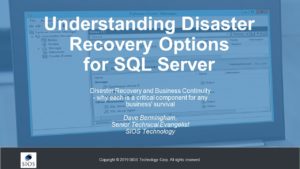
Webinar: Understanding Disaster Recovery Options for SQL Server

May 24, 2019 by Jason Aw Leave a Comment

Understanding Disaster Recovery Options for SQL Server

Webinar: Understanding Disaster Recovery Options for SQL Server

Webinar: Understanding Disaster Recovery Options for SQL Server

Yes – you need a disaster recovery plan! Your SQL Server data depends on it.

On this webinar, Dave Bermingham, Microsoft Datacenter and Cloud MVP, explains the difference between Disaster Recovery, Business Continuity and High Availability and why each is a critical component for any business’ survival. Discover what key components should be included in your Disaster Recovery, Business Continuity plans and explore some of the tools available to help achieve your Disaster Recovery, Business Continuity goals.

Concerned about end of support for SQL Server 2008?  See how SIOS helps customers prepare for SQL Server 2008 EOS.

Filed Under: News posts Tagged With: Business Continuity, disaster recovery, disaster recovery - DR, High Availability, SQL Server

Webinar: Best Practices for running SQL Server on AWS Elastic Cloud Compute

May 24, 2019 by Jason Aw Leave a Comment

Best Practices for running SQL Server on AWS Elastic Cloud Compute (EC2)

Webinar: Best Practices for running SQL Server on AWS Elastic Cloud Compute (EC2)

Running SQL Server in the cloud doesn’t have to be complicated or anxiety-inducing. Cloud Service Providers (CSPs) like AWS, have optimized their infrastructure to run SQL Server with price, performance and availability as key requirements. This webinar covers how AWS in partnership with SIOS, addresses those three requirements in their industry leading IaaS offering, EC2.

Register Webinar: Best Practices for running SQL Server on AWS Elastic Cloud Compute (EC2)

Filed Under: News and Events Tagged With: AWS Cloud, High Availability, SQL Server

  • « Previous Page
  • 1
  • …
  • 37
  • 38
  • 39
  • 40
  • 41
  • …
  • 57
  • Next Page »

Recent Posts

  • IT Resilience vs. Disaster Recovery: Which Strategy Does Your Business Need?
  • SAP High Availability and Disaster Recovery Outside RISE with SAP
  • Fail Open vs. Fail Closed: Why It’s a False Dilemma (and How True HA Fixes It)
  • The 5-Step Checklist for Validating Your Failover Setup
  • Managing an Inherited DataKeeper Cluster: Challenges and Best Practices

Most Popular Posts

Maximise replication performance for Linux Clustering with Fusion-io
Failover Clustering with VMware High Availability
create A 2-Node MySQL Cluster Without Shared Storage
SAP for High Availability Solutions For Linux
Bandwidth To Support Real-Time Replication
The Availability Equation – High Availability Solutions.jpg
Choosing Platforms To Replicate Data - Host-Based Or Storage-Based?
Guide To Connect To An iSCSI Target Using Open-iSCSI Initiator Software
Best Practices to Eliminate SPoF In Cluster Architecture
Step-By-Step How To Configure A Linux Failover Cluster In Microsoft Azure IaaS Without Shared Storage azure sanless
Take Action Before SQL Server 20082008 R2 Support Expires
How To Cluster MaxDB On Windows In The Cloud

Join Our Mailing List

Copyright © 2026 · Enterprise Pro Theme on Genesis Framework · WordPress · Log in