SIOS SANless clusters

SIOS SANless clusters High-availability Machine Learning monitoring

  • Home
  • Products
    • SIOS DataKeeper for Windows
    • SIOS Protection Suite for Linux
  • News and Events
  • Clustering Simplified
  • Success Stories
  • Contact Us
  • English
  • 中文 (中国)
  • 中文 (台灣)
  • 한국어
  • Bahasa Indonesia
  • ไทย

Press Release: SIOS Webinar Will Discuss High Availability Options for Microsoft SQL Server in Virtual and Cloud Environments

March 12, 2015 by sios2017

SAN MATEO, CA – March 12, 2015 – SIOS Technology Corp. (www.us.sios.com), maker of SAN and #SANLess clustering software products, today announced a live webinar featuring Microsoft MVP, MCM and MCSM Denny Cherry that will discuss some of the high availability options available for Microsoft SQL Server in virtual server and cloud environments.

Titled, “High Availability, Disaster Recovery, Low Cost Storage in Virtual and Cloud Environments,” this webinar will be held on Thursday, March 19 at 10:00 AM PDT / 1:00 PM EDT.  To register, please visit:  http://us.sios.com/2015-03-webinar

This live, 30 minute webinar is for enterprises using SQL Server that are concerned about high availability (HA), disaster recovery (DR) and low cost storage options to protect SQL data from downtime in VMware, Hyper-V, Azure, AWS, and other environments where traditional shared storage clusters are not an option. Denny will review some of the problems (both technological and financial) with these options, and how you can overcome these various problems. The webinar will conclude with a live Q&A session.

About the Speaker
Denny Cherry is the owner and principal consultant for Denny Cherry & Associates Consulting and has over a decade of experience working with platforms such as Microsoft SQL Server, Hyper-V, vSphere and Enterprise Storage solutions. Denny’s areas of technical expertise include system architecture, performance tuning, security, replication and troubleshooting. Denny currently holds several of the Microsoft Certifications related to SQL Server for versions 2000 through 2012 including the Microsoft Certified Master as well as being a Microsoft MVP for several years.  Denny has written several books and dozens of technical articles on SQL Server management and how SQL Server integrates with various other technologies.

About SIOS Technology Corp.

SIOS Technology Corp. makes SAN and #SANLess software solutions that make clusters easy to use and easy to own.An essential part of any cluster solution, SIOS SAN and #SANLess software provides the flexibility to build Clusters Your Way™ to protect your choice of Windows or Linux environment in any configuration (or combination) of physical, virtual and cloud (public, private, and hybrid) without sacrificing performance or availability. The unique SIOS #SANLess clustering solution allows you to configure clusters with local storage, eliminating both the cost and the single-point-of-failure risk of traditional shared (SAN) storage.

Founded in 1999, SIOS Technology Corp. (www.us.sios.com) is headquartered in San Mateo, California, and has offices throughout the United States, United Kingdom and Japan.

# # #

SIOS, SIOS Technology, SIOS DataKeeper, SIOS Protection Suite, Clusters Your Way, and associated logos are registered trademarks or trademarks of SIOS Technology Corp. and/or its affiliates in the United States and/or other countries. All other trademarks are the property of their respective owners.

Contact

Beth Winkowski
Winkowski Public Relations, LLC for SIOS
Phone: 978-649-7189
Email: bethwinkowski@US.SIOS.com

Filed Under: News and Events, Press Releases Tagged With: #SANLess Clusters for Windows Environments, Cloud, Denny Cherry, MSSQLTips, VMware

VMblog.com: High Availability vSphere for SQL Server: 5 Things You Need to Know

February 11, 2015 by Margaret Hoagland

SQL Server administrators have many options for implementing high availability (HA) in a VMware environment. VMware offers vSphere HA. Microsoft offers Windows Server Failover Clustering (WSFC). And SQL Server in WSFC has its own HA options with AlwaysOn Availability Groups and AlwaysOn Failover Clusters.

Third party vendors also provide solutions purpose-built for HA and disaster recovery, and these often integrate with other solutions to create even more options. For example, some solutions leverage the AlwaysOn Failover Cluster feature included with SQL Server to deliver robust HA and data protection for less than the cost of AlwaysOn Availability Groups that require the more expensive Enterprise Edition.

This article highlights five things every SQL Server administrator should know before formulating a high availability strategy for mission-critical applications in a vSphere environment. Such a strategy is likely to resemble the multi-site configuration shown in Figure 1, which is not possible with some HA options.

1. High-Availability Clusters for vSphere require Raw Disk Mapping

The layers of abstraction used in virtualized servers afford substantial flexibility, but such abstractions can cause problems when a virtual machine (VM) must interface with a physical device. This is the case for vSphere with Storage Area Networks (SANs).

To enable compatibility with certain SAN and other shared-storage features, such as I/O fencing and SCSI reservations, vSphere utilizes a technology called Raw Device Mapping (RDM) to create a direct link through the hypervisor between the VM and the external storage system. The requirement for using RDM with shared storage exists for any cluster, including a SQL Server Failover Cluster.

In a traditional cluster created with WSFC in vSphere, RDM must beused to provide virtual machines (VMs) direct access to the underlying storage (SAN). RDM is able to maintain 100 percent compatibility with all SAN commands, making virtualized storage access seamless to the operating system and applications which is an essential requirement of WSFC.

RDM can be made to work effectively, but achieving the desired result is not always easy, and may not even be possible. For example, RDM does not support disk partitions, so it is necessary to use “raw” or whole LUNs (logical unit numbers), and mapping is not available for direct-attached block storage and certain RAID devices.

2. Use of Raw Disk Mapping means Sacrificing Popular VMware Features

Another important aspect of being fully informed about RDM involves understanding the hurdles it can create for using other VMware features, many of which are popular with SQL Server administrators. When these hurdles are deemed unacceptable, as they often are, they eliminate Raw Device Mapping as an option for implementing high availability.

The underlying problem is how RDM interferes with VMware features that employ virtual machine disk (VMDK) files. For example, RDM prevents the use of VMware snapshots, and this in turn prevents the use of any feature that requires snapshots, such as Virtual Consolidated Backups (VCBs).

Raw Disk Mapping also complicates data mobility, which creates impediments to using the features that make server virtualization so beneficial, including converting VMs into templates to simplify deployment, and using vMotion to migrate VMs dynamically among hosts.

Another potential problem for transaction-intensive applications like SQL Server is the inability to utilize Flash Read Cache when RDM is configured.

3. Shared Storage can create a Single Point of Failure

The traditional need for clustered servers to have direct access to shared storage can create limitations for high availability and disaster recovery provisions, and these limitations can, in turn, create a barrier to migrating business-critical applications to vSphere.

In a traditional failover cluster, two or more physical servers (cluster nodes) are connected to a shared storage system. The application runs on one server, and in the event of a failure, clustering software, such as Windows Server Failover Clustering, moves the application to a standby node. Similar clustering is also possible with virtualized servers in a vSphere environment, but this requires a technology like Raw Disk Mapping so that the VMs can access the shared storage directly.

Whether the servers are physical or virtual, the use of shared storage can create a single point of failure. A SAN can have a high availability configuration, of course, but that increases its complexity and cost, and can adversely affect performance, especially for transaction-intensive applications like SQL Server.

4. HA vSphere Clusters can be built without Sacrificing VMware Functionality

Some third-party solutions are purpose-built to overcome the limitations associated with shared storage and the requirement to use RDM with SQL Server’s AlwaysOn Failover Clusters and Windows Server Failover Clusters.

Figure 1 – A multi-site high-availability configuration protects applications from outages that affect an entire data center.

The best of these solutions provide complete configuration flexibility, making it possible to create a SANLess cluster to meet a wide range of needs – from a two-node cluster in a single site, to a multinode cluster, to a cluster with nodes in different geographic locations for disaster protection as shown in Figure 1. Some of these solutions also make it possible to implement LAN/WAN-optimized, real-time block-level replication in either a synchronous or asynchronous manner. In effect, these solutions are capable of creating a RAID 1 mirror across the network, automatically changing the direction of the data replication (source and target) as needed after failover and failback.

Just as importantly, a SANLess cluster is often easier to implement and operate with both physical and virtual servers. For example, for solutions that are integrated with WSFC, administrators are able to configure high-availability clusters using a familiar feature in a way that avoids the use of shared storage as a potential single point of failure. Once configured, most solutions then automatically synchronize the local storage in two or more servers (in one or more data centers), making them appear to WSFC as if it was a shared storage device.

5. HA SANLess Clusters deliver Superior Capabilities and Performance

In addition to creating a single point of failure, replicating data on a SAN can significantly reduce throughput performance in VMware environments. Highly transactional applications like SQL Server are particularly vulnerable to these performance-related factors.
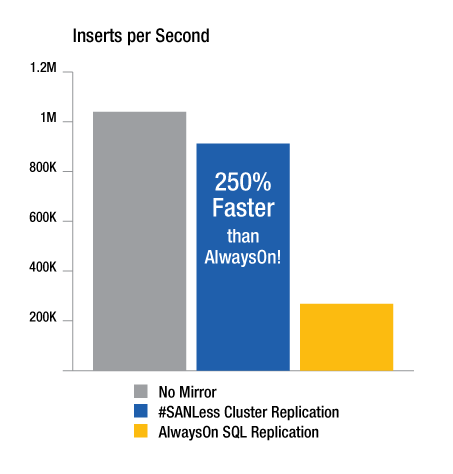
Figure 2 – Testing of SQL Server’s AlwaysOn Availability Groups and SIOS #SANLess clusters shows the throughput advantage possible with replication techniques purpose built for high availability and high performance.

Figure 2 summarizes test results that show the 60-70 percent performance penalty associated with using SQL Server AlwaysOn Availability Groups to replicate data. These test results also show how a purpose-built high-availability SANLess cluster, which utilizes local storage, is able to perform nearly as well as configurations not protected with any data replication or mirroring.

The #SANLess cluster tested is able to achieve this impressive performance because its driver sits immediately below NTFS. As writes occur on the primary server, the driver writes one copy of the block to the local VMDK and another copy simultaneously across the network to the secondary server which has its own independent VMDK.

SANLess clusters have many other advantages, as well. For example, those that use block-level replication technology that is fully integrated with WSFC are able to protect the entire SQL Server instance, including the database, logons and agent jobs-all in an integrated fashion. Contrast this approach with AlwaysOn Availability Groups, which failover only user-defined databases, and require IT staff to manage other data objects for every cluster node separately and manually.

##

About the Author

Jerry Melnick, COO, SIOS Technology Corp.

Jerry Melnick (jmelnick@us.sios.com) is responsible for defining corporate strategy and operations at SIOS Technology Corp. (www.us.sios.com), maker of SIOS SAN and #SANLess cluster software (www.clustersyourway.com). He more than 25 years of experience in the enterprise and high availability software industries. He holds a Bachelor of Science degree from Beloit College with graduate work in Computer Engineering and Computer Science at Boston University.

Filed Under: News and Events, News posts Tagged With: #SANLess, Jerry Melnick, News, VMware

Press Release: SIOS Clustering 101 Webinar Series Will Examine Best Practices in Maximizing SQL Application Availability in a VMware Environment

January 22, 2015 by sios2017

SAN MATEO, CA – January 22, 2015 – SIOS Technology Corp. (www.us.sios.com), maker of SAN and #SANLess clustering software products, today announced that the next session in its Clustering 101 webinar series featuring Microsoft Clustering MVP Dave Bermingham will examine high availability clusters in VMware environments.

Titled, “VMware Guest Based High Availability Clusters – Ways to Protect SQL and Maintain Flexibility,” this webinar will be held on Wednesday, January 28 at 10:00 AM PST / 1:00 PM EST.  To register, please visit:  http://us.sios.com/2015-01-clustering101/

This live, 30-minute webinar will address questions including: How do you maximize availability and comprehensively protect SQL applications in a VMware environment without sacrificing IT flexibility or important VMware features? Can you have a cluster and multisite replication with VMware? Participants can tweet their questions prior to the event to @SIOSTech using #Clustering101 or bring their questions and comments to the session.

David Bermingham is recognized within the technology community as a high availability expert and has been honored by his peers by being elected to be a Microsoft MVP in clustering since 2010. David’s work as director, technical evangelist at SIOS Technology Corp., has him focused on Microsoft high availability and disaster recovery solutions as well as providing hands on support, training and professional services for cluster implementations. David holds numerous technical certifications and draws from more than twenty years of experience in IT, including work in the finance, healthcare and education fields, to help organizations design solutions to meet their high availability and disaster recovery needs. Learn more at www.us.sios.com

About Clustering 101

Clustering 101 is a webinar series hosted by Microsoft MVP Dave Bermingham focused on addressing the numerous facets of clustering for high availability and data replication. Webinars in this series are held the fourth Wednesday of every month at 10:00 AM PST / 1:00 PM EST. Check the SIOS website for details: http://us.sios.com/about/news-events/

About SIOS Technology Corp.

SIOS Technology Corp. makes SAN and #SANLess software solutions that make clusters easy to use and easy to own.An essential part of any cluster solution, SIOS SAN and #SANLess software provides the flexibility to build Clusters Your Way™ to protect your choice of Windows or Linux environment in any configuration (or combination) of physical, virtual and cloud (public, private, and hybrid) without sacrificing performance or availability. The unique SIOS #SANLess clustering solution allows you to configure clusters with local storage, eliminating both the cost and the single-point-of-failure risk of traditional shared (SAN) storage.

Founded in 1999, SIOS Technology Corp. (www.us.sios.com) is headquartered in San Mateo, California, and has offices throughout the United States, United Kingdom and Japan.

# # #

SIOS, SIOS Technology, SIOS DataKeeper, SIOS Protection Suite, Clusters Your Way, and associated logos are registered trademarks or trademarks of SIOS Technology Corp. and/or its affiliates in the United States and/or other countries. All other trademarks are the property of their respective owners.

# # #

Contact:

Beth Winkowski
Winkowski Public Relations, LLC for SIOS
Phone: 978-649-7189
Email: bethwinkowski@US.SIOS.com

Filed Under: News and Events, Press Releases Tagged With: Clustering 101, VMware, Webinar

Live Webinar: Clustering 101 — VMware Guest Based High Availability Clusters – Ways to Protect SQL and Maintain Flexibility

January 13, 2015 by Margaret Hoagland Leave a Comment

Want to protect SQL in a VMware environment without sacrificing IT flexibility or important VMware features? Can you have a cluster and multisite replication with VMware? Learn how in in this 30 minute webinar.  Microsoft Clustering MVP, Dave Bermingham will address these questions and more. You can participate before the event by tweeting your questions to @SIOSTech using #Clustering101 and of course bring your own questions and comments.

Register Now

Date: January 28, 2014
Time: 10:00a PST — 1:00pm EST

About Clustering 101 Series

Clustering 101 is a webinar series hosted by Microsoft MVP, Dave Bermingham focused on addressing the numerous facets of clustering for high availability, data replication and any combination there of. This series will air monthly, the fourth Wednesday of the month at 10:00a PST / 1:00p EST.

About Dave Bermingham

David Bermingham is recognized within the technology community as a high availability expert and has been honored by his peers by being elected to be a Microsoft MVP in clustering since 2010. David’s work as director, technical evangelist at SIOS Technology Corp., has him focused on Microsoft high availability and disaster recovery solutions as well as providing hands on support, training and professional services for cluster implementations. David holds numerous technical certifications and draws from more than twenty years of experience in IT, including work in the finance, healthcare and education fields, to help organizations design solutions to meet their high availability and disaster recovery needs. Learn more at www.us.sios.com

Filed Under: Event posts, News and Events Tagged With: #SANLess Clusters for SQL Server Environments, Clustering 101, VMware, Webinar

Marketwatch: SIOS Technology Webinar to Reveal Steps for Achieving High Availability for SQL in VMware While Maximizing IT Flexibility

January 12, 2015 by Margaret Hoagland

 SIOS Technology Corp. (www.us.sios.com), maker of SAN and #SANLess clustering software products, today announced a live webinar that will detail how to implement high availability (HA) protection for SQL in a VMware environment without sacrificing IT flexibility or data mobility features.

The live webinar “High Availability for SQL in VMware without Raw Device Mapping” will be held on Thurs, January 15, 2015 at 10:00 AM PST / 1:00 PM EST presented by SIOS Technology Director of Field Engineering/SIOS clustering expert Tony Tomarchio.

To register, please visit here: http://us.sios.com/2015-01-webinar-vmware

Using traditional shared storage clusters for high availability in a VMware environment requires the use of Raw Device Mapping (RDM) which limits IT configurations and does not support important VMware features, such as Vmotion. In this webinar, Tony Tomarchio will demonstrate easy steps to create a failover cluster without RDM to protect SQL without sacrificing IT flexibility or VMware features.

At SIOS Technology, Tony Tomarchio is responsible for defining and delivering technical pre-sales services, support and best practices to SIOS customers, prospects and partners. Tony has more than a decade of experience providing systems management and high availability solutions to enterprise customers.

About SIOS Technology Corp.

SIOS Technology Corp. makes SAN and #SANLess software solutions that make clusters easy to use and easy to own. An essential part of any cluster solution, SIOS SAN and #SANLess software provides the flexibility to build Clusters Your Way to protect your choice of Windows or Linux environment in any configuration (or combination) of physical, virtual and cloud (public, private, and hybrid) without sacrificing performance or availability. The unique SIOS #SANLess clustering solution allows you to configure clusters with local storage, eliminating both the cost and the single-point-of-failure risk of traditional shared (SAN) storage.

Founded in 1999, SIOS Technology Corp. (www.us.sios.com) is headquartered in San Mateo, California, and has offices throughout the United States, United Kingdom and Japan.

SIOS, SIOS Technology, SIOS DataKeeper, SIOS Protection Suite, Clusters Your Way, and associated logos are registered trademarks or trademarks of SIOS Technology Corp. and/or its affiliates in the United States and/or other countries. All other trademarks are the property of their respective owners.

SOURCE: SIOS Technology Corp.

Winkowski Public Relations, LLC for SIOS
Beth Winkowski, 978-649-7189
bethwinkowski@US.SIOS.com

Copyright Business Wire 2015

Read more at Marketwatch.com

Filed Under: News and Events, News posts Tagged With: News, VMware, Webinar

  • « Previous Page
  • 1
  • …
  • 3
  • 4
  • 5
  • 6
  • Next Page »

Recent Posts

  • The Critical Role of QA and Production Environments in High Availability
  • The Danger of Turn It Off, Turn It Back On Again Thinking in High Availability
  • SIOS Partnerships
  • Common Customer Misconceptions
  • DataKeeper

Most Popular Posts

Maximise replication performance for Linux Clustering with Fusion-io
Failover Clustering with VMware High Availability
create A 2-Node MySQL Cluster Without Shared Storage
SAP for High Availability Solutions For Linux
Bandwidth To Support Real-Time Replication
The Availability Equation – High Availability Solutions.jpg
Choosing Platforms To Replicate Data - Host-Based Or Storage-Based?
Guide To Connect To An iSCSI Target Using Open-iSCSI Initiator Software
Best Practices to Eliminate SPoF In Cluster Architecture
Step-By-Step How To Configure A Linux Failover Cluster In Microsoft Azure IaaS Without Shared Storage azure sanless
Take Action Before SQL Server 20082008 R2 Support Expires
How To Cluster MaxDB On Windows In The Cloud

Join Our Mailing List

Copyright © 2026 · Enterprise Pro Theme on Genesis Framework · WordPress · Log in