SIOS SANless clusters

SIOS SANless clusters High-availability Machine Learning monitoring

  • Home
  • Products
    • SIOS DataKeeper for Windows
    • SIOS Protection Suite for Linux
  • News and Events
  • Clustering Simplified
  • Success Stories
  • Contact Us
  • English
  • 中文 (中国)
  • 中文 (台灣)
  • 한국어
  • Bahasa Indonesia
  • ไทย

Steeleye Datakeeper Cluster Edition Wins Windows It Pro Best High Availability/Disaster Recovery Awards

January 20, 2018 by Jason Aw Leave a Comment

I am pleased to announce that Windows IT Pro has awarded SteelEye DataKeeper Cluster Edition the Best High Availability and Disaster Recovery Product in two categories; Community Choice Gold Award and Editors’ Best Silver Award.


SteelEye DataKeeper Cluster Edition - Best High Availability Disaster Recover ProductSteelEye DataKeeper Cluster Edition - Best High Availability Disaster Recover Product

I am really proud to be a part of the SteelEye DataKeeper team and I appreciate all of the Windows IT Pro community that voted for us in the Community Choice award!

Reproduced with permission from https://clusteringformeremortals.com/2009/11/20/steeleye-datakeeper-cluster-edition-wins-windows-it-pro-best-high-availabilitydisaster-recovery-awards/

Filed Under: Clustering Simplified, Datakeeper Tagged With: DataKeeper, DataKeeper Cluster Edition, disaster recovery, High Availability, Windows IT Pro

Deploy 2-node File Server Failover Cluster in Azure using ARM

July 19, 2017 by Jason Aw Leave a Comment

Deploy 2-node File Server Failover Cluster In Azure Using ARM

In this post we will detail the specific steps required to deploy a 2-node File Server Failover Cluster in a single region of Azure using Azure Resource Manager. I will assume you are familiar with basic Azure concepts as well as basic Failover Cluster concepts and will focus this article on what is unique about deploying a File Server Failover Cluster in Azure.

With DataKeeper Cluster Edition you are able to take the locally attached storage, whether it is Premium or Standard Disks, and replicate those disks either synchronously, asynchronously or a mix or both, between two or more cluster nodes. In addition, a DataKeeper Volume resource is registered in Windows Server Failover Clustering which takes the place of a Physical Disk resource. Instead of controlling SCSI-3 reservations like a Physical Disk Resource, the DataKeeper Volume controls the mirror direction, ensuring the active node is always the source of the mirror. As far as Failover Clustering is concerned, it looks, feels and smells like a Physical Disk and is used the same way Physical Disk Resource would be used.

Pre-Requisites

  • You have used the Azure Portal before and are comfortable deploying virtual machines in Azure IaaS.
  • Have obtained a license or eval license of SIOS DataKeeper

Deploying A File Server Failover Cluster Instance Using The Azure Portal

To build a 2-node File Server Failover Cluster Instance in Azure, we are going to assume you have a basic Virtual Network based on Azure Resource Manager and you have at least one virtual machine up and running and configured as a Domain Controller. Once you have a Virtual Network and a Domain configured, you are going to provision two new virtual machines which will act as the two nodes in our cluster.

Our environment will look like this:

DC1 – Our Domain Controller and File Share Witness
SQL1 and SQL2 – The two nodes of our File Server Cluster

Provisioning The Two Cluster Nodes (SQL1 And SQL2)

Using the Azure Portal, we will provision both SQL1 and SQL2 exactly the same way. There are numerous options to choose from including instance size, storage options, etc. This guide is not meant to be an exhaustive guide to deploying Servers in Azure as there are some really good resources out there and more published every day. However, there are a few key things to keep in mind when creating your instances, especially in a clustered environment.

Availability Set – It is important that both SQL1, SQL2 AND DC1 reside in the same availability set. By putting them in the same Availability Set we are ensuring that each cluster node and the file share witness reside in a different Fault Domain and Update Domain. This helps guarantee that during both planned maintenance and unplanned maintenance the cluster will continue to be able to maintain quorum and avoid downtime.

3
Figure 3 – Be sure to add both cluster nodes and the file share witness to the same Availability Set

STATIC IP ADDRESS

Once each VM is provisioned, you will want to go into the setting and change the settings so that the IP address is Static. We do not want the IP address of our cluster nodes to change.

4
Figure 4 – Make sure each cluster node uses a static IP

Storage

As far as Storage is concerned, you will want to consult Performance best practices for SQL Server in Azure Virtual Machines. In any case, you will minimally need to add at least one additional disk to each of your cluster nodes. DataKeeper can use Basic Disk, Premium Storage or even Storage Pools consisting of multiple disks in a storage pool. Just be sure to add the same amount of storage to each cluster node and configure it identically. Also, be sure to use a different storage account for each virtual machine to ensure that a problem with one Storage Account does not impact both virtual machines at the same time.

5
Figure 5 – make sure to add additional storage to each cluster node

Create The Cluster

Assuming both cluster nodes (SQL1 and SQL2) have been provisioned as described above and added to your existing domain, we are ready to create the cluster. Before we create the cluster, there are a few Features that need to be enabled. These features are .Net Framework 3.5 and Failover Clustering. These features need to be enabled on both cluster nodes. You will also need to enable the FIle Server Role.

6
Figure 6 – enable both .Net Framework 3.5 and Failover Clustering features and the File Server on both cluster nodes

Once that role and those features have been enabled, you are ready to build your cluster. Most of the steps I’m about to show you can be performed both via PowerShell and the GUI. However, I’m going to recommend that for this very first step you use PowerShell to create your cluster. If you choose to use the Failover Cluster Manager GUI to create the cluster you will find that you wind up with the cluster being issues a duplicate IP address.

Without going into great detail, what you will find is that Azure VMs have to use DHCP. By specifying a “Static IP” when we create the VM in the Azure portal all we did was create sort of a DHCP reservation. It is not exactly a DHCP reservation because a true DHCP reservation would remove that IP address from the DHCP pool. Instead, this specifying a Static IP in the Azure portal simply means that if that IP address is still available when the VM requests it, Azure will issue that IP to it. However, if your VM is offline and another host comes online in that same subnet it very well could be issued that same IP address.

There is another strange side effect to the way Azure has implemented DHCP. When creating a cluster with the Windows Server Failover Cluster GUI when hosts use DHCP (which they have to), there is not option to specify a cluster IP address. Instead it relies on DHCP to obtain an address. The strange thing is, DHCP will issue a duplicate IP address, usually the same IP address as the host requesting a new IP address. The cluster will usually complete, but you may have some strange errors and you may need to run the Windows Server Failover Cluster GUI from a different node in order to get it to run. Once you get it to run you will want to change the cluster IP address to an address that is not currently in use on the network.

You can avoid that whole mess by simply creating the cluster via Powershell and specifying the cluster IP address as part of the PowerShell command to create the cluster.

You can create the cluster using the New-Cluster command as follows:

New-Cluster -Name cluster1 -Node sql1,sql2 -StaticAddress 10.0.0.101 -NoStorage

After the cluster creation completes, you will also want to run the cluster validation by running the following command:

Test-Cluster

7
Figure 7 – The output of the cluster creation and the cluster validation commands

Create The File Share Witness

Because there is no shared storage, you will need to create a file share witness on another server in the same Availability Set as the two cluster nodes. By putting it in the same availability set you can be sure that you only lose one vote from your quorum at any given time. If you are unsure how to create a File Share Witness you can review this article http://www.howtonetworking.com/server/cluster12.htm. In my demo I put the file share witness on domain controller. I have published an exhaustive explanation of cluster quorums at https://blogs.msdn.microsoft.com/microsoft_press/2014/04/28/from-the-mvps-understanding-the-windows-server-failover-cluster-quorum-in-windows-server-2012-r2/

Install DataKeeper

After the cluster is created it is time to install DataKeeper. It is important to install DataKeeper after the initial cluster is created so the custom cluster resource type can be registered with the cluster. If you installed DataKeeper before the cluster is created you will simply need to run the install again and do a repair installation.

8
Figure 8 – Install DataKeeper after the cluster is created

During the installation you can take all of the default options.  The service account you use must be a domain account and be in the local administrators group on each node in the cluster.

9
Figure 9 – the service account must be a domain account that is in the Local Admins group on each node

Once DataKeeper is installed and licensed on each node you will need to reboot the servers.

Create The DataKeeper Volume Resource

To create the DataKeeper Volume Resource you will need to start the DataKeeper UI and connect to both of the servers.
10Connect to SQL1
11

Connect to SQL2
12

Once you are connected to each server, you are ready to create your DataKeeper Volume. Right click on Jobs and choose “Create Job”
13

Give the Job a name and description.
14

Choose your source server, IP and volume. The IP address is whether the replication traffic will travel.
15 - File Server Failover Cluster

Choose your target server.
16

Choose your options. For our purposes where the two VMs are in the same geographic region we will choose synchronous replication. For longer distance replication you will want to use asynchronous and enable some compression.
17

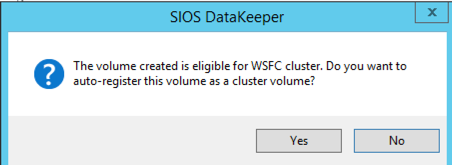
By clicking yes at the last pop-up you will register a new DataKeeper Volume Resource in Available Storage in Failover Clustering.
18

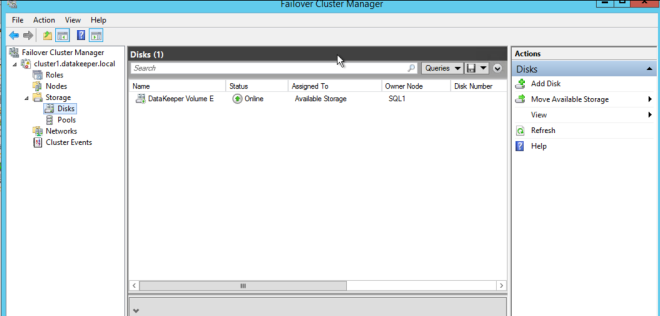
You will see the new DataKeeper Volume Resource in Available Storage.
19

Create The File Server Cluster Resource

To create the File Server Cluster Resource, we will use Powershell once again rather than the Failover Cluster interface. This is when the virtual machines are configured to use DHCP, the GUI based wizard will not prompt us to enter a cluster IP address. Instead, it will issue a duplicate IP address. To avoid this, we will use a simple powershell command to create the FIle Server Cluster Resource and specify the IP Address

Add-ClusterFileServerRole -Storage "DataKeeper Volume E" -Name FS2 -StaticAddress 10.0.0.201

Make note of the IP address you specify here. It must be a unique IP address on your network. We will use this same IP address later when we create our Internal Load Balancer.

Create The Internal Load Balancer

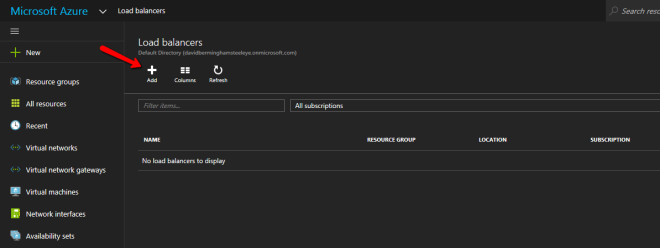
Here is where failover clustering in Azure is different than traditional infrastructures. The Azure network stack does not support gratuitous ARPS, so clients cannot connect directly to the cluster IP address. Instead, clients connect to an internal load balancer and are redirected to the active cluster node. What we need to do is create an internal load balancer. This can all be done through the Azure Portal as shown below.

First, create a new Load Balancer
30

You can use an Public Load Balancer if your client connects over the public internet. But assuming your clients reside in the same vNet, we will create an Internal Load Balancer. The important thing to take note of here is that the Virtual Network is the same as the network where your cluster nodes reside. Also, the Private IP address that you specify will be EXACTLY the same as the address you used to create the SQL Cluster Resource.
31

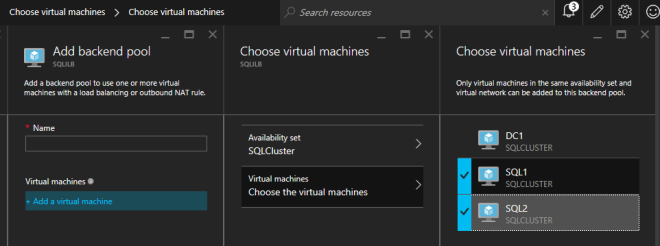
After the Internal Load Balancer (ILB) is created, you will need to edit it. The first thing we will do is to add a backend pool. Through this process you will choose the Availability Set where your SQL Cluster VMs reside. However, when you choose the actual VMs to add to the Backend Pool, be sure you do not choose your file share witness. We do not want to redirect SQL traffic to your file share witness.
32
33

The next thing we will do is add a Probe. The probe we add will probe Port 59999. This probe determines which node is active in our cluster.
34

And then finally, we need a load balancing rule to redirect the SMB traffic, TCP port 445 The important thing to notice in the screenshot below is the Direct Server Return is Enabled. Make sure you make that change.

445_ilb

Fix The File Server IP Resource

The final step in the configuration is to run the following PowerShell script on one of your cluster nodes. This will allow the Cluster IP Address to respond to the ILB probes and ensure that there is no IP address conflict between the Cluster IP Address and the ILB. Please take note; you will need to edit this script to fit your environment. The subnet mask is set to 255.255.255.255, this is not a mistake, leave it as is. This creates a host specific route to avoid IP address conflicts with the ILB.

# Define variables
$ClusterNetworkName = “” 
# the cluster network name 
(Use Get-ClusterNetwork on Windows Server 2012 of higher to find the name)
$IPResourceName = “” 
# the IP Address resource name 
$ILBIP = “” 
# the IP Address of the Internal Load Balancer (ILB)
Import-Module FailoverClusters
# If you are using Windows Server 2012 or higher:
Get-ClusterResource $IPResourceName | Set-ClusterParameter 
-Multiple @{Address=$ILBIP;ProbePort=59999;SubnetMask="255.255.255.255";
Network=$ClusterNetworkName;EnableDhcp=0}
# If you are using Windows Server 2008 R2 use this: 
#cluster res $IPResourceName /priv enabledhcp=0 address=$ILBIP probeport=59999  
subnetmask=255.255.255.255

Creating File Shares

You will find that using the File Share Wizard in Failover Cluster Manager does not work. Instead, you will simply create the file shares in Windows Explorer on the active node. Failover clustering automatically picks up those shares and puts them in the cluster.

Note that the”Continuous Availability” option of a file share is not supported in this configuration.

Conclusion

You should now have a functioning File Server Failover Cluster. If you have ANY problems, please reach out to me on Twitter @daveberm. Need a DataKeeper evaluation key fill out the form at http://us.sios.com/clustersyourway/cta/14-day-trial and SIOS will send an evaluation key sent out to you.

Reproduced with permission from Clusteringformeremortals

Filed Under: Clustering Simplified, Datakeeper Tagged With: #SANLess, #SANLess Clusters for SQL Server Environments, #SANLess Clusters for Windows Environments, Azure, DataKeeper Cluster Edition, file server failover cluster, highly available cluster, MSSQLTips, SQL Server

Press Release: Enterprises Adopt SIOS Technology SANLess Clustering Software on Amazon Web Services for Cloud HA and DR

May 11, 2015 by sios2017

SAN MATEO, CA – May 11, 2015 – SIOS Technology Corp. (www.us.sios.com), maker of SAN and #SANLess clustering software products, today announced that leading enterprise companies are turning to its SANLess clustering software, SIOS DataKeeper Cluster Edition, to provide high availability (HA) and disaster recovery (DR) of critical data on business critical applications in Amazon Web Services cloud environments.  Some of these enterprises include Gulliver International, a Tokyo-based pre-owned car company; Epicure Selections, Canada’s leading direct sales company; and Spirent, a global leader in communications test and measurement.

“Business critical applications require high availability protection, regardless of where they are deployed,” said Jerry Melnick, COO, SIOS Technology. “In the cloud, you need to protect applications from downtime just as you do in a physical server environment. However, traditional solutions, such as shared-storage clusters may not be practical or even possible in the cloud. With SIOS SANLess clustering software, enterprises are able to use traditional Windows Server Failover Clustering to provide high availability and disaster recovery protection for SQL Server and other enterprise applications in the cloud without the limitations of shared storage.”

Most cloud providers enable a measure of disaster protection by allowing enterprises to use multiple separate and redundant data centers or computing resources. However, they do not offer shared storage (i.e., a SAN), which is required to support traditional Microsoft Windows Server Failover Clustering (WSFC) for high availability. SANless software can be added to a WSFC to create a high availability cluster without the need for shared storage. With it, companies can quickly and easily run their business critical applications, such as SQL Server, SAP, Siebel Gateway, and others, in a cloud environment without sacrificing high availability protection.

Gulliver International

To accommodate rapid growth, Gulliver has instituted a “cloud-first” policy for all new applications and chose to move all of its internal IT systems to Amazon Web Services (AWS). They are using WSFC and SIOS DataKeeper Cluster Edition software to build SANless, cloud-based clusters to provide high availability protection for important applications. SANless clusters enable them to deploy their application in AWS in minutes and to manage their clusters without changes to their WSFC procedures.

“We would not consider moving our applications to the cloud without an efficient, easy-to-implement high availability solution,” said Manabu Tsukishima, IT manager, Gulliver International.

Epicure Selections

Epicure Selections uses two instances of SQL Server Standard Edition: a public website that provides product, company, and consultant enrollment information to its network of 16,000 consultants and an internal website that enables consultants to place product orders. Using SIOS DataKeeper clustering software they created a two-node cluster in a failover configuration that enables each SQL instance to failover independently. One cluster node is in their data center and the second node is in the Amazon cloud. SIOS software enables them to provide HA and DR protection using the cloud instead of needing to build out a remote DR location or to buy costly SQL Server Enterprise Edition application licenses.

“The SIOS software has allowed us to create a hybrid solution providing additional cost savings of running on-premises with the reliability and flexibility of running in the cloud,” said Russell Born, senior network infrastructure administrator, Epicure. “Knowing that a website outage will result in an automatic failover allows our IT Team to focus their attention on other priorities to strengthen our business.”

Spirent Communications

Spirent decided to move its entire data center to the cloud. For this move to be successful, Spirent IT staff needed to provide high availability for its Siebel Gateway Server and File Server application environments. Spirent chose SIOS DataKeeper Cluster Edition and built two-node clusters in the cloud using standard WSFC and adding SIOS DataKeeper Cluster Edition software as an ingredient. The SIOS software uses efficient, real-time replication to synchronize storage between instances in different Availability Zones, making them appear to WSFC as a SAN. The solution was fast and easy to deploy, allowing them to protect their business’ most important applications and to successfully move to a cloud-first data center.

“We were able to configure the clusters just as we would in a WSFC environment so we did not need specialized skills or a SAN administrator,” said Sohamn Chatterjee, senior business systems architect, Spirent. “The SIOS software enabled us to implement our move to the cloud efficiently.”

About SIOS Technology Corp.

SIOS Technology Corp. makes SAN and #SANLess software solutions that make clusters easy to use and easy to own. An essential part of any cluster solution, SIOS SAN and #SANLess software provides the flexibility to build Clusters Your Way™ to protect your choice of Windows or Linux environment in any configuration (or combination) of physical, virtual and cloud (public, private, and hybrid) without sacrificing performance or availability. The unique SIOS #SANLess clustering solution allows you to configure clusters with local storage, eliminating both the cost and the single-point-of-failure risk of traditional shared (SAN) storage.
Founded in 1999, SIOS Technology Corp. (www.us.sios.com) is headquartered in San Mateo, California, and has offices throughout the United States, United Kingdom and Japan.

# # #

SIOS, SIOS Technology, SIOS DataKeeper, SIOS Protection Suite, Clusters Your Way, and associated logos are registered trademarks or trademarks of SIOS Technology Corp. and/or its affiliates in the United States and/or other countries. All other trademarks are the property of their respective owners.

Contact

Beth Winkowski
Winkowski Public Relations, LLC for SIOS
Phone: 978-649-7189
Email: bethwinkowski@US.SIOS.com

Filed Under: News and Events, Press Releases Tagged With: Amazon AWS, Amazon EC2, Amazon Web Services, Customer Story, DataKeeper Cluster Edition, Epicure Selections, Gulliver International, Spirent

Storage Newsletter: Spirent Communications Provides HA in Cloud With SIOS

March 17, 2015 by Margaret Hoagland

SIOS Technology Corp., maker of SAN and SANLess clustering software products, announced that Spirent Communications plc is using its DataKeeper Cluster Edition to protect its business critical applications in the Amazon EC2 cloud.

Because the SIOS software is integrated with Windows Server Failover Clustering (WSFC), it did not add complexity and was easy for Spirent IT staff to deploy.

Spirent is a specialist in communications test and measurement with 20 locations in 15 countries worldwide. The company develops hardware and software solutions and test methodologies for the communications industry.The Spirent IT department is looking for ways to improve efficiency and maintain high QoS to customers. They recognized that moving their operations to the Amazon cloud would provide benefits.

“We saw an opportunity to gain significant flexibility, scalability, and efficiency by moving to the Amazon EC2 cloud,” said Sohamn Chatterjee, senior business systems architect, Spirent. “This move lets us grow quickly and apply additional IT resources as our needs change.”

For the move to the cloud to be successful, Spirent IT staff needed to provide HA for its Siebel Gateway Server and File Server application environments.

“We could not move important applications to the cloud until we were sure that we would not be putting them at risk for downtime or data loss,” said Chatterjee. “The traditional shared storage clusters that we would have used in a physical environment require shared storage, which is not available in EC2.”

Spirent chose SIOS DataKeeper Cluster Edition to protect its business critical applications. They built two-node clusters in the cloud using standard WSFC and adding SIOS DataKeeper Cluster Edition software as an ingredient. The SIOS software uses real-time replication to synchronize storage between instances in different availability zones, making them appear to WSFC as a SAN.

“We were able to configure the clusters just as we would in a WSFC environment so we did not need specialized skills or a SAN administrator,” said Chatterjee. “The SIOS software enabled us to implement our move to the cloud efficiently.”

The SIOS software provided the protection Spirent needed to move its important applications to the cloud. Since their cluster deployment, they have not experienced any downtime or data loss in their Siebel or File Server environments. They have also found the SIOS SANLess clusters make failover/failback testing fast and easy.

“We are very pleased with the SIOS software and the protection our SIOS SANLess clusters provide for both our Siebel Gateway Server and File Server application environments in the Amazon EC2 cloud,” said Chatterjee.

“An essential ingredient in any cluster solution, SIOS SAN and SANLess clustering software provides the flexibility to build clusters to protect any choice of Windows or Linux environment and any configuration (or combination) of physical, virtual and cloud (public, private, and hybrid) storage, without sacrificing performance or availability,” said Jerry Melnick, COO, SIOS. “We are very impressed with Spirent’s innovative use case with two node clusters in the cloud.”

Filed Under: News and Events, News posts Tagged With: Amazon EC2, Cloud, DataKeeper Cluster Edition, News, Spirent

Press Release: SIOS SANLess Clustering Software Provides Epicure Selections with High Availability and Disaster Recovery Protection for Critical SQL Server Applications

January 20, 2015 by sios2017

Epicure Selections deploys hybrid solution providing additional cost savings of running on-premises with the reliability and flexibility of running in the cloud 

SAN MATEO, CA – January 20, 2015 – SIOS Technology Corp. (www.us.sios.com), maker of SAN and #SANLess clustering software products, today announced that Epicure Selections is using SIOS DataKeeper Cluster Edition software to easily and cost-efficiently provide HA and DR protection for its business-critical SQL Server applications without the complexity of building out a remote DR site or purchasing costly SQL Server Enterprise Edition licenses.

Epicure, Canada’s leading direct sales company, sells healthy, easy-to-prepare food products through a network of over 16,000 consultants.  Epicure relies on two websites for its critical business operations. Its public website provides product, company, and consultant enrollment information to customers and people interested in becoming a consultant. The internal website provides consultants with important product information and enables them to place orders.

The company uses two instances of SQL Server Standard Edition, one for each website running on a single server. “Our websites are vital to our business,” said Russell Born, senior network infrastructure administrator at Epicure.

As the company grew and expanded its products and services, the Epicure IT department needed to update and protect its business-critical websites from downtime. It decided to move both websites from a third-party hosted facility to its on-premises data center and Amazon Web Services. As part of this update, Epicure wanted an efficient, cost-effective way to provide high availability and disaster protection for both websites while continuing to run them on two instances of SQL Server Standard Edition.

Using SIOS SANLess clustering software, Epicure IT staff created a two-node cluster in an active-passive failover configuration that enables each SQL instance to failover independently. One cluster node is in the on-premises data center and the second node is in an instance of the AWS EC2 cloud. Epicure IT staff created the SIOS SANLess clusters and configured them using the software’s intuitive graphical user interface.

The SIOS software provides Epicure with an easy, cost-efficient way to provide HA and DR protection for its business-critical SQL Server applications without the complexity of building out a remote DR site or purchasing costly SQL Server Enterprise Edition licenses. “The SIOS software has allowed us to create a hybrid solution providing additional cost savings of running on-premises with the reliability and flexibility of running in the cloud,” said Born. “Knowing that a website outage will result in an automatic failover allows our IT Team to focus their attention on other priorities to strengthen our business.”

“Whether you want to protect applications in a physical server, a private cloud within an organization, in a public cloud or a hybrid cloud, you need to protect applications, like Windows SQL Server, from downtime if the cloud instance or the cloud provider fails,” said Jerry Melnick, COO, SIOS Technology.  “Epicure is using SIOS to provide a fast, easy way to deploy applications in a high availability environment in the cloud while continuing to use Windows Server Failover Clustering.  I applaud them for their use case and innovation and look forward to continuing to provide value to their HA and DR strategies.”

About SIOS Technology Corp.

SIOS Technology Corp. makes SAN and #SANLess software solutions that make clusters easy to use and easy to own.An essential part of any cluster solution, SIOS SAN and #SANLess software provides the flexibility to build Clusters Your Way™ to protect your choice of Windows or Linux environment in any configuration (or combination) of physical, virtual and cloud (public, private, and hybrid) without sacrificing performance or availability. The unique SIOS #SANLess clustering solution allows you to configure clusters with local storage, eliminating both the cost and the single-point-of-failure risk of traditional shared (SAN) storage.

Founded in 1999, SIOS Technology Corp. (www.us.sios.com) is headquartered in San Mateo, California, and has offices throughout the United States, United Kingdom and Japan.

# # #

SIOS, SIOS Technology, SIOS DataKeeper, SIOS Protection Suite, Clusters Your Way, and associated logos are registered trademarks or trademarks of SIOS Technology Corp. and/or its affiliates in the United States and/or other countries. All other trademarks are the property of their respective owners.

Contact

Beth Winkowski
Winkowski Public Relations, LLC for SIOS
Phone: 978-649-7189
Email: bethwinkowski@US.SIOS.com

Filed Under: News and Events, Press Releases Tagged With: #SANLess Clusters for SQL Server Environments, Cloud, Customer Story, DataKeeper Cluster Edition, Hybrid Cloud

  • « Previous Page
  • 1
  • 2
  • 3
  • 4
  • 5
  • 6
  • Next Page »

Recent Posts

  • High Availability for On-Premises Data Centers
  • How APM Tools and High Availability Clusters Improve Network Resilience
  • Selecting the Right Storage for SQL Server High Availability in the Cloud
  • Disaster Recovery Planning in an Unpredictable World
  • Active-Active vs. Active-Passive

Most Popular Posts

Maximise replication performance for Linux Clustering with Fusion-io
Failover Clustering with VMware High Availability
create A 2-Node MySQL Cluster Without Shared Storage
SAP for High Availability Solutions For Linux
Bandwidth To Support Real-Time Replication
The Availability Equation – High Availability Solutions.jpg
Choosing Platforms To Replicate Data - Host-Based Or Storage-Based?
Guide To Connect To An iSCSI Target Using Open-iSCSI Initiator Software
Best Practices to Eliminate SPoF In Cluster Architecture
Step-By-Step How To Configure A Linux Failover Cluster In Microsoft Azure IaaS Without Shared Storage azure sanless
Take Action Before SQL Server 20082008 R2 Support Expires
How To Cluster MaxDB On Windows In The Cloud

Join Our Mailing List

Copyright © 2026 · Enterprise Pro Theme on Genesis Framework · WordPress · Log in